
Construction first aid training equips workers with the life-saving skills to manage severe bleeding, traumatic injuries, falls, electrical incidents, and cardiac emergencies in the critical minutes before EMS arrives. Under 29 CFR 1926.50, if a clinic, hospital, or physician is not reasonably accessible in terms of time and distance, a person with a valid first-aid certificate must be on site. That is the compliance floor. Here is what to do today:
- Verify EMS access. If your nearest emergency facility is not reasonably accessible in terms of time and distance, assign at least one certified first-aider per shift before work resumes.
- Check your first-aid kits. Confirm kits are stocked, weatherproof, and placed at accessible locations across the site.
- Schedule on-site training. Book a hands-on, instructor-led course that covers construction-specific hazards, not a generic office-safety program.
- Pull your standards. Keep copies of OSHA 29 CFR 1926.50, OSHA Appendix A (ANSI Z308.1 kit guidance), and AHA/ILCOR or American Red Cross CPR protocols in your site safety file.
Table of Contents
- What does a construction first aid course have to cover?
- What do OSHA and the standards actually require?
- Which training format works best for a construction site?
- How do you vet a first aid training provider for your crew?
- What goes in a construction site first aid kit?
- Why does hands-on, scenario-based training produce better outcomes?
- Key Takeaways
- What site supervisors consistently get wrong about first aid training
- Homefrontcpr brings certified first aid training directly to your site
What does a construction first aid course have to cover?
A course built for office workers will not cut it on a job site. Construction crews face hazards that demand specific skills, and a training program that skips any of the following is incomplete.
Mandatory topic areas:
- Severe bleeding control: tourniquet application (CAT or SOFTT-W style), wound packing with hemostatic dressings, and direct pressure technique
- Traumatic injuries: amputation management, crush injury stabilization, and fracture immobilization
- Falls and head injuries: spinal precautions, level of consciousness assessment, and safe patient positioning
- Electrical injuries: power isolation steps before any patient contact, recognizing entry/exit wounds, and the requirement to seek professional care for all electrical burns
- Airway and breathing management: head-tilt/chin-lift, recovery position, and rescue breathing
- Shock recognition and management: positioning, warmth, and monitoring until EMS arrives
- CPR and AED use: adult chest compressions to AHA/ILCOR depth and rate standards, two-rescuer CPR, and AED pad placement on a manikin
Skills practice must go beyond watching a demonstration. Learners should apply a tourniquet under simulated time pressure, perform two full minutes of chest compressions on an adult manikin, control bleeding on a wound model, and practice safe patient movement with a partner.
Scenario examples that belong in every construction course:
- A worker falls from scaffolding: spinal precaution, airway check, bleeding control, and calling EMS
- A struck-by incident with a machinery arm: crush injury stabilization and shock management
- An electrocution: power isolation, no-touch assessment, then CPR if the worker is unresponsive and not breathing
- A deep laceration with arterial bleeding: tourniquet application within 60 seconds
Pro Tip: Run scenarios in groups of 4–6, rotating roles every 10–15 minutes so every learner plays both responder and bystander. Role rotation forces decision-making under mild pressure and consistently improves skill retention compared to passive observation.
What do OSHA and the standards actually require?
The regulatory picture is straightforward once you know where to look.
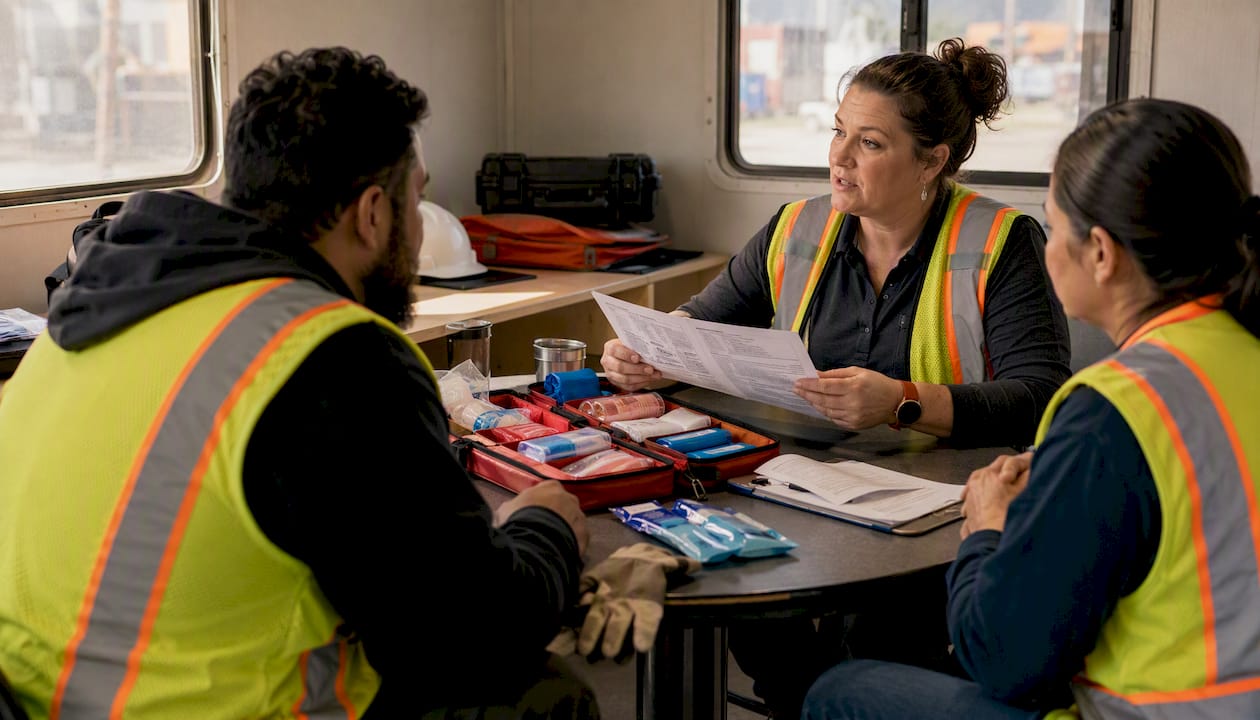
29 CFR 1926.50 sets the baseline: when an infirmary, clinic, hospital, or physician is not reasonably accessible, a certified first-aider must be available at the worksite. "Reasonably accessible" is not defined as a fixed number in the regulation itself, but OSHA interpretation guidance has treated 3–4 minutes as the practical threshold for high-risk worksites. If your site EMS response time exceeds that, you need trained personnel on site, not just a phone number.
Standards and guidance to reference:
- ANSI Z308.1: the baseline for minimum first-aid kit contents, referenced in OSHA Appendix A to 1926.50; non-mandatory but widely used as the compliance benchmark
- AHA/ILCOR guidelines: the clinical standard for CPR compression depth, rate, and AED protocols
- American Red Cross and National Safety Council (NSC): both issue certificates that satisfy the "equivalent training" language in 29 CFR 1926.50
- OSHA interpretation letters: document your time-and-distance analysis and file the relevant letters with your safety records
Documentation checklist — collect this from every provider:
- Course title and full scope of content
- Certifying body (AHA, American Red Cross, NSC, or equivalent)
- Instructor name and credentials
- Training date and location
- Signed attendance roster
- Skills-check results per learner
- Certificate copies with expiration dates
- Renewal/recertification schedule
OSHA also recommends documenting any arrangements with outside emergency responders if you are relying on off-site EMS rather than on-site personnel. That documentation belongs in the site safety file, not just in someone's email inbox.
Large projects with access complications — gated entries, remote road conditions, multi-story structures — carry heightened compliance risk when relying solely on off-site responders. Supervisors on those sites should treat on-site certification as the default, not the fallback.
Which training format works best for a construction site?
| Format | Typical length | Hands-on time | Best for | Key requirement |
|---|---|---|---|---|
| On-site instructor-led | 4 hours | 60%+ of session | Large crews, high-hazard sites | Space for manikins, AED trainers, PPE |
| Blended (eLearning + skills check) | 2–3 hrs online + 2 hrs in-person | Skills check session | Multi-shift sites, scheduling constraints | Provider must document competency-based skills testing |
| Classroom (off-site) | 4 hours | Moderate | Small groups, pre-mobilization | Travel time; less site-specific scenario relevance |
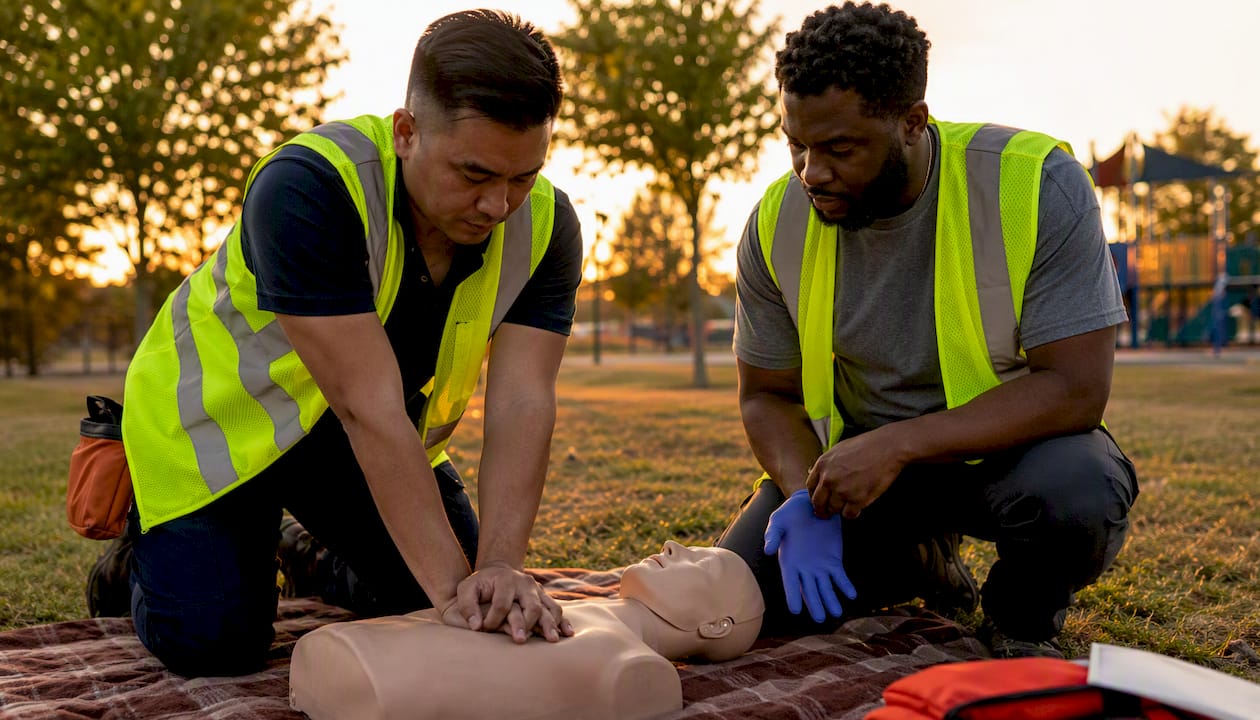
Blended formats are acceptable under OSHA when the provider documents instructor-verified competency for practical skills. A completion certificate from the online module alone does not satisfy the skills requirement. OSHA interpretation guidance is clear: supervisors should request a skills-check roster, not just course completion records.
On-site logistics checklist:
- A flat, covered space at least 20 × 20 feet for manikin stations
- Noise control (schedule away from heavy equipment operation)
- One adult manikin and one AED trainer per 4–6 learners
- Gloves and face shields for bloodborne pathogen precautions
- Roster with worker names and IDs for recordkeeping
- Schedule sessions at shift change or pre-task to minimize production impact
Pro Tip: Keep instructor-to-learner ratios at 1:6 or better for skills-intensive sessions. Above 1:10, instructors cannot observe and correct technique in real time — and uncorrected bad form on chest compressions is worse than no training at all.
How do you vet a first aid training provider for your crew?
Ask every candidate provider these questions before signing anything:
Questions to ask:
- Which certifying body issues the certificates (AHA, American Red Cross, NSC)?
- Are instructors RN-, EMT-, or AHA-certified? Can you verify credentials?
- How many hands-on minutes does each learner get per session?
- What is the maximum class size?
- Can you provide a sample syllabus with construction-specific scenarios?
- How are skills checks documented and delivered to the employer?
- Will you customize scenarios for our specific job hazards (electrical, heavy machinery, heights)?
Red flags that disqualify a provider:
- Lecture-only format with no hands-on skills check
- Instructor credentials not verifiable or not disclosed
- No site-specific scenario content
- Vague certification claims ("industry-recognized" without naming the certifying body)
- No written documentation of skills-check results
Scaling across a site or multi-shift project:
- Stagger training by crew rotation so at least one certified worker is present on every shift
- Plan recertification before the two-year mark (AHA/Red Cross standard) or per your safety program's shorter cycle
- For multi-site projects, mobile on-site teams are more practical than busing crews to a central location
- Request all documentation in writing before the session date, not after
What goes in a construction site first aid kit?
ANSI Z308.1 sets the minimum contents baseline but is explicitly non-mandatory and was not designed with construction hazards in mind. Treat it as the floor, then build up from there based on your job-hazard analysis.
Additions beyond ANSI Z308.1 minimums for construction:
- Hemostatic dressings and additional tourniquets for high-bleeding-risk work
- Burn dressings for electrical and welding work
- Saline eyewash for chemical or concrete dust exposure
- Cervical collars or SAM splints for fall-from-height sites
- Extra nitrile gloves and CPR face shields for bloodborne pathogen compliance
OSHA Appendix A requires supplies in weatherproof containers with individually sealed packages, checked before each job dispatch and at least weekly. Log every check, note any expended or expired items, and restock before the next shift.
Placement guidance: On linear sites (pipelines, road construction), place kits no more than a 3-minute walk from any active work zone. In multi-story construction, keep a kit on every occupied floor and in crew trailers. Mark locations with high-visibility signage.
Pro Tip: Assign kit inspection to a named person per shift, not "everyone." Shared responsibility means no one checks. A signed weekly log with the inspector's name is your documentation if OSHA asks.
Why does hands-on, scenario-based training produce better outcomes?
The answer comes down to what happens in the first minutes after an injury. OSHA's core intent is ensuring life-saving care is available before EMS arrives, because that gap is where outcomes are determined. A worker who has only watched a video will hesitate. A worker who has applied a tourniquet under a timed drill will not.
Construction-focused scenario drills build confidence to act on severe bleeding, falls, crush injuries, and electrical incidents — the exact emergencies most likely on a job site. Cognitive knowledge alone does not transfer to hands under stress.
RN-led instruction adds a layer that EMT-only or lay-instructor models often miss: clinical judgment in patient assessment. An RN can coach realistic patient-handling technique, correct airway management errors in real time, and explain why a specific intervention matters physiologically, not just procedurally. That context sticks.
What a high-quality provider delivers:
- Mobile skills sessions brought to your site, not a classroom across town
- AHA-aligned CPR and AED protocols with documented skills checks
- Scenario content matched to your specific job hazards
- Certificates issued same day or within 24 hours
Competency check template to request after training:
- Tourniquet application: correct placement and tightening within 60 seconds
- Bleeding control: wound packing technique assessed by instructor
- CPR performance: 2-minute compression cycle at correct depth and rate
- AED setup: pad placement and shock delivery on trainer unit
- Scenario debrief: learner can verbalize decision sequence for one assigned scenario
Pro Tip: File the skills-check roster alongside attendance records in your site safety file. If OSHA audits, a certificate alone is weaker evidence of competency than a signed skills assessment.
Key Takeaways
OSHA-compliant construction first aid training requires verified hands-on skills practice, site-specific scenario content, and documented competency records kept in the site safety file.
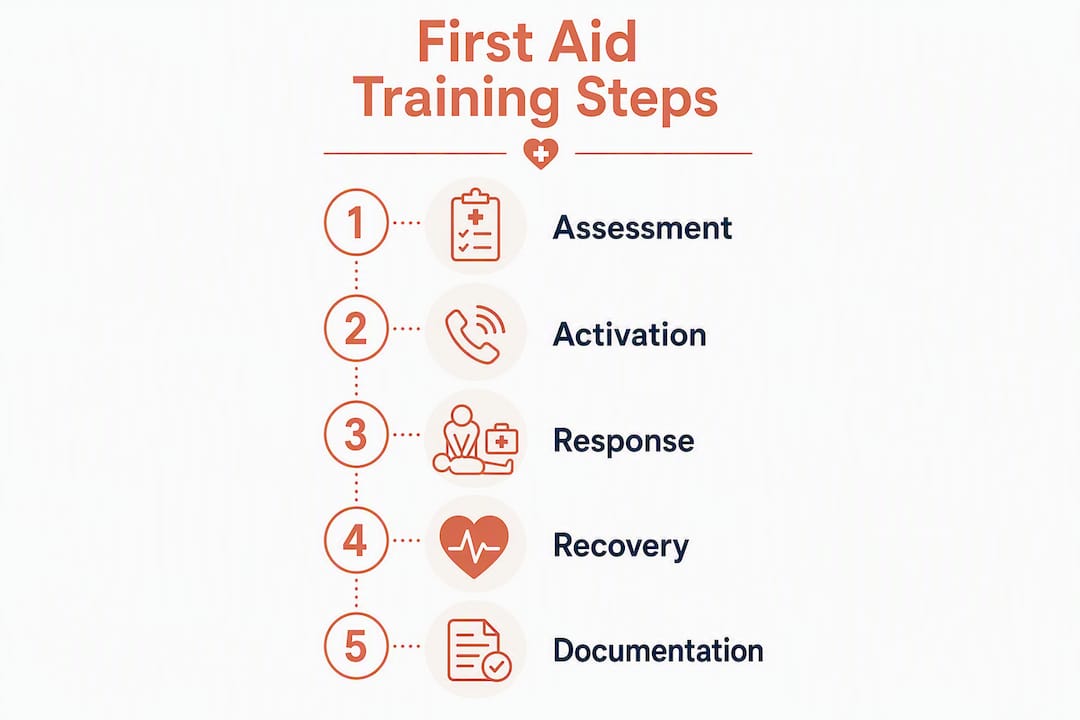
| Point | Details |
|---|---|
| OSHA compliance trigger | If emergency medical services cannot reach your site within a few minutes, a certified first-aider must be present on every shift. |
| Course content minimum | Training must cover severe bleeding, CPR/AED, falls, electrical injuries, crush injuries, and shock management. |
| Documentation required | Collect course scope, certifying body, instructor credentials, attendance roster, and skills-check results. |
| Kit inspection schedule | Check first-aid kits before each job dispatch and at least weekly; log every inspection by name. |
| Homefrontcpr option | Homefrontcpr delivers mobile, RN-led, AHA-aligned first aid and CPR certification directly to your Charlotte-area construction site. |
What site supervisors consistently get wrong about first aid training
The most common failure is treating certification as a checkbox rather than a competency. A crew member who sat through a four-hour class two years ago and received a laminated card is not the same as a crew member who can apply a tourniquet in under a minute while someone is shouting at them. Those are different things, and the gap between them shows up in emergencies.
Classes that are too large are the second most frequent problem. When an instructor is managing 20 learners, no one gets enough hands-on repetitions. Skills fade fast without repetition, and a single run-through on a manikin is not enough to build muscle memory.
The fix is straightforward: smaller groups, more scenario repetitions, and training integrated into the rhythm of the site. A 15-minute scenario drill at a toolbox talk is more valuable for retention than a once-a-year recertification marathon. Pre-task planning is another underused opportunity. Reviewing emergency response steps before a high-risk task, even briefly, primes workers to act rather than freeze.
One anonymized example: a mid-size commercial site in the Southeast added a monthly 20-minute hands-on drill to its pre-shift routine after an RN-led initial certification. When a worker sustained a severe laceration six months later, a colleague applied direct pressure and a tourniquet correctly before EMS arrived. The site supervisor credited the repeated practice, not the original certification class.
Homefrontcpr brings certified first aid training directly to your site
Construction supervisors in the Charlotte area have a concrete alternative to sending crews off-site for training: Homefrontcpr comes to you. RN-led instruction means your crew gets clinical-grade coaching on tourniquet application, chest compressions, and AED use, matched to the hazards on your specific job site, not a generic curriculum.
Before booking, prepare the following: a covered flat space for manikin stations, your expected headcount per session, shift windows that work for your crew rotation, and a list of your site's primary hazards so the instructor can tailor scenarios. Certificates are issued fast, and skills-check documentation is delivered in writing so it goes straight into your safety file.
To get started, request a course scope and sample competency checklist from Homefrontcpr before confirming your session date. That document tells you exactly what your crew will be able to do when training ends.
Authoritative resources for OSHA, standards, and certifying bodies
- OSHA 29 CFR 1926.50 — Medical services and first aid: the primary regulation governing first aid requirements on construction sites; consult for the "reasonably accessible" rule and certificate requirements
- OSHA Appendix A to 1926.50: references ANSI Z308.1 for kit contents and sets the inspection frequency requirement; use for kit audits
- OSHA interpretation letter on first aid and CPR requirements: clarifies the 3–4 minute EMS access standard and documentation expectations; file with your site safety records
- OSHA emergency medical services interpretation (AED guidance): addresses AED requirements on construction sites
- eCFR — 29 CFR 1926.50: current regulatory text with ANSI Z308.1 reference; use for legal interpretation
- American Heart Association (AHA): consult AHA guidelines for CPR compression depth, rate, and AED protocols when evaluating certifying bodies
- American Red Cross and National Safety Council (NSC): both issue certificates that satisfy the "equivalent training" language in 29 CFR 1926.50; verify instructor credentials through each organization's provider directory