
Online CPR certification is valid for some purposes but not for most jobs that require it. If you need a certificate for personal awareness or a nonclinical workplace safety program, an online-only course often works for these purposes. If you work in healthcare, need BLS or ACLS compliance, or your employer follows OSHA guidelines, an online-only certificate typically will not be accepted. The credential that clears most professional hurdles is a blended course: online coursework paired with a hands-on skills check.
- Online-only accepted: personal preparedness, general community awareness, some nonclinical volunteer roles (always confirm with the organization first)
- Online-only not accepted: nursing, EMT, hospital staff, clinical settings, BLS/ACLS requirements, OSHA-regulated workplaces, most state licensing boards
- The fix: a blended course that includes an in-person skills session and issues an AHA- or ARC-recognized completion card
Pro Tip: Before enrolling in any online course, email your HR department or licensing board and ask in writing whether the specific course and certifying body meet their requirements. A five-minute email saves you from repeating the whole process.
Table of Contents
- What does "valid" actually mean for a CPR certificate?
- How do online-only, blended, and in-person CPR courses compare?
- Which jobs and settings accept online-only CPR certification?
- Checklist: how to confirm your CPR certificate will be accepted
- How long do CPR courses take, what do they cost, and what should the card show?
- Why hands-on practice produces better CPR than online training alone
- Need an accepted certificate fast? Homefrontcpr comes to you in Charlotte, NC
- Key Takeaways
- The case for skipping the gamble on online-only
- Authoritative sources worth checking
What does "valid" actually mean for a CPR certificate?
"Valid" means three different things depending on who is asking.
Employer acceptance is the most common concern. HR departments and hiring managers check whether the certifying body is recognized (typically the American Heart Association or American Red Cross), whether the course included a skills demonstration, and whether the card is current. A certificate from an unrecognized online provider, even a polished one, can be rejected on the spot.
Regulatory and licensing acceptance is stricter. State nursing boards, hospital credentialing offices, and OSHA-regulated programs specify not just the certifying body but the course format. Many require proof that a qualified instructor observed and signed off on your skills.
Card validity refers to the physical or digital completion card itself: who issued it, whether it notes a skills check, and when it expires.
The American Heart Association's Heartsaver CPR AED Online course is structured as blended learning — learners complete the online portion first, then must finish a hands-on skills session at an AHA Training Center to receive the official two-year completion card. The online module alone does not produce a recognized card.
That structure tells you everything about what the AHA considers a complete, credentialed course.
How do online-only, blended, and in-person CPR courses compare?
The three delivery modes differ in ways that directly affect whether your certificate will be accepted.
Online-only covers theory, recognition of cardiac arrest, and the steps of CPR through video and interactive modules. No instructor observes your technique. No mannequin practice is required. The result is a completion certificate, not an AHA or ARC course card.
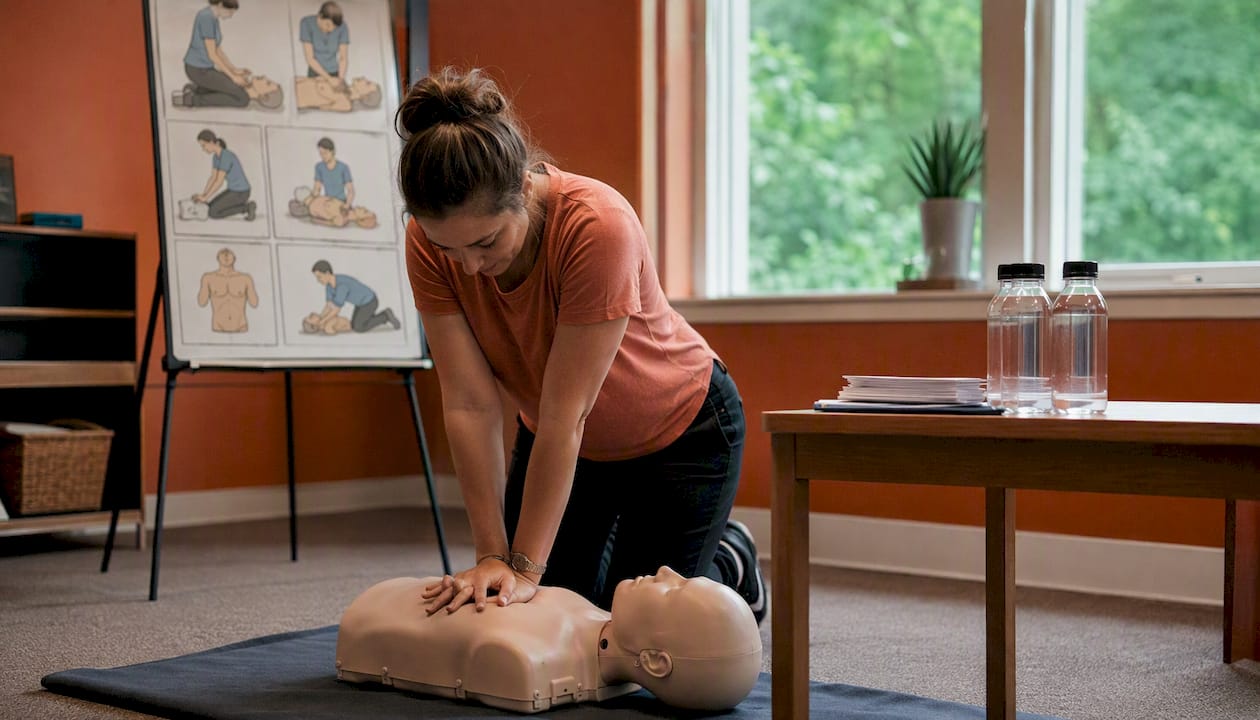
Blended learning combines an online module with a required in-person skills session. An instructor watches you perform compressions and rescue breaths on a mannequin, corrects your technique, and signs off on competency. Research comparing BLS training methods found that a remote self-directed blended approach achieved similar performance to classroom-based courses, though it required more retakes to reach the same standard.
Fully in-person puts you in a classroom with an instructor and mannequins from start to finish. It generally takes several hours and is the format most healthcare employers and licensing boards prefer.
| Mode | Employer/Regulator Acceptance | Skills Demonstration | Typical Completion Time | Card Issued |
|---|---|---|---|---|
| Online-only | Limited (nonclinical only) | None | Short duration | Completion certificate only |
| Blended | Widely accepted (AHA/ARC aligned) | Required (in-person) | Online + skills session | AHA/ARC card, 2-year validity |
| Fully in-person | Broadly accepted | Required | Several hours | AHA/ARC card, 2-year validity |
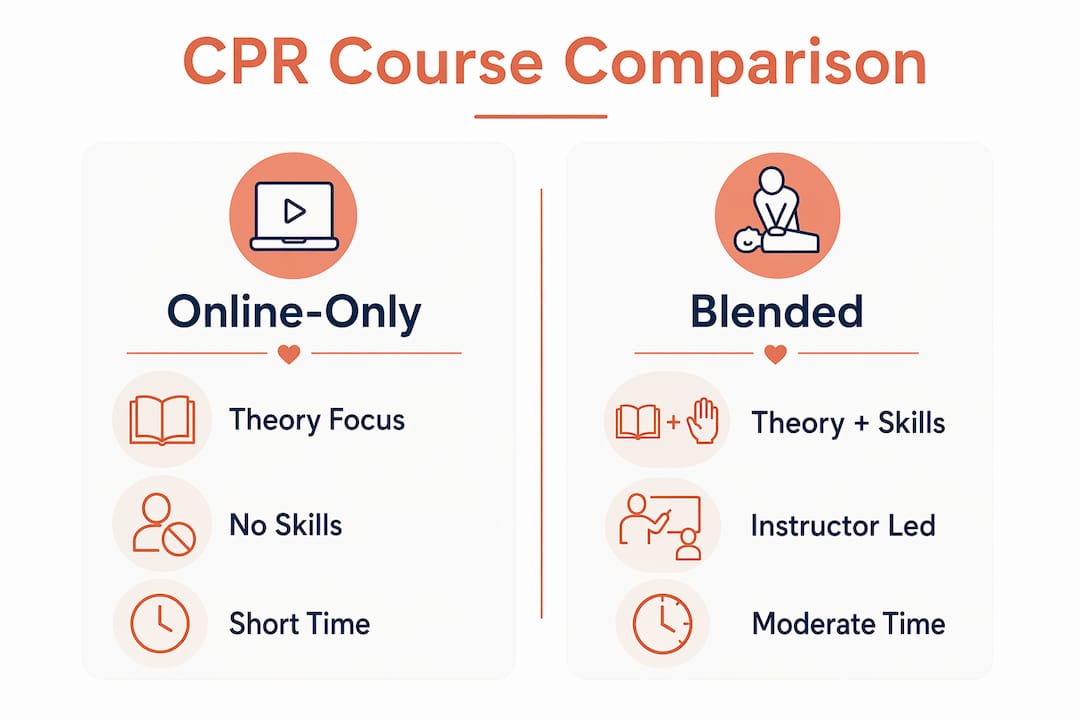
The AHA's Heartsaver blended model makes the skills session mandatory before any card is issued, which is why blended courses carry the same weight as fully in-person ones for most employers.
Which jobs and settings accept online-only CPR certification?
The short answer: fewer than most people expect.
Settings where online-only often works:
- Personal preparedness with no employer requirement
- Some community volunteer programs with no clinical contact
- Nonclinical corporate wellness awareness programs (not OSHA-mandated)
Settings that require blended or fully in-person:
- Hospitals, clinics, and any licensed healthcare facility
- Nursing, EMT, paramedic, and respiratory therapy roles
- Childcare centers and schools (most state licensing boards require a skills check)
- Gyms and fitness facilities where staff are required to hold BLS
- Any role where OSHA or a state board specifies the certifying body and format
Pro Tip: Send that one-line email before you spend money on any course. Keep the written reply on file — you may need it during onboarding or a license renewal audit.
Checklist: how to confirm your CPR certificate will be accepted
- Identify the certifying body. Check whether the course is issued by the AHA, American Red Cross, or another body your employer or licensing board names explicitly.
- Confirm a skills-demonstration requirement. Ask whether the course includes an in-person or instructor-observed skills check, and whether that check is documented on the card.
- Check the card validity period. Most AHA and ARC cards are valid for two years. Confirm your employer's renewal deadline matches.
- Get written acceptance from HR or your licensing board. Use the one-line email template in the section above. Do not rely on a verbal "that should be fine."
- Request course documentation. Ask for the course syllabus or learning objectives, the instructor's name and ID number, and confirmation that a skills check is noted on the completion card.
- Verify the instructor's credentials. An AHA-authorized instructor should be able to provide their AHA instructor ID. An RN-led course adds clinical credibility for healthcare settings.
How long do CPR courses take, what do they cost, and what should the card show?
Time and cost vary by mode and provider.
| Mode | Typical Time | Typical Cost Range |
|---|---|---|
| Online-only | Short duration | — |
| Blended (online + skills) | Online module plus skills session | Moderate cost range |
| Fully in-person | Several hours | Higher cost range |
Group training, mobile travel fees, and RN-led instruction affect the final price. On-site sessions for workplaces or schools often include a per-learner rate plus a travel fee, which can make the per-person cost lower than individual enrollment.
A legitimate completion card should show:
- Issuing organization (AHA, ARC, or equivalent)
- Instructor name and ID number
- Skills-check notation confirming in-person competency was assessed
- Issuance and expiration dates (two-year validity is standard for AHA Heartsaver)
- Course name (e.g., Heartsaver CPR AED, BLS Provider)
- Digital or physical format — both are acceptable; digital cards from AHA are verifiable online
Why hands-on practice produces better CPR than online training alone
The gap between knowing CPR and performing it correctly under pressure is wider than most people realize.
A randomized study of 108 medical undergraduates found that mannequin-based training produced significantly better chest compression depth and rate than online content-based training. Knowledge scores were comparable, but physical technique was not.
Clinical researchers consistently find that online modules convey knowledge effectively but cannot replace in-person corrective feedback for physical CPR quality, specifically compression rate and depth.
The reason is mechanical. Correct compression depth (at least 2 inches for adults) requires muscle memory built through repetition on a physical mannequin, not from watching a video. An instructor watching in real time catches problems — locked elbows, shallow compressions, wrong hand placement — that a learner cannot self-diagnose. A randomized controlled study using instructor-led distance learning with feedback devices found outcomes comparable to classroom training, reinforcing that the feedback itself matters more than the physical location.
Pro Tip: When booking a blended or in-person session, ask whether the class uses QCPR-enabled manikins or feedback devices that display compression depth and rate in real time. That immediate data loop accelerates skill acquisition faster than instructor verbal cues alone.
Need an accepted certificate fast? Homefrontcpr comes to you in Charlotte, NC
If your online certificate was rejected, or you want to skip that risk entirely, Homefrontcpr delivers AHA-aligned, RN-led CPR and First Aid training directly to your location anywhere in Charlotte, NC.
Courses available:
- CPR for Healthcare Providers (BLS-aligned)
- Heartsaver CPR/AED
- First Aid
- Infant and child CPR workshops
- Blended learning skills checks for learners who completed an online module
- Group and private on-site sessions for workplaces, schools, gyms, and families
How it works: Submit an online inquiry or call to schedule. Same-week availability is typically possible for groups. Homefrontcpr comes to your office, school, gym, or home with all equipment. The RN instructor runs skills practice, provides real-time corrective feedback, and issues AHA-aligned completion cards before leaving.
Group pricing is charged per learner, with a travel fee for locations outside the immediate Charlotte area. Private sessions for individuals or small families are also available.
Key Takeaways
Online-only CPR certification is generally not sufficient for healthcare, BLS/ACLS, or OSHA-regulated roles — a blended course with an in-person skills check is the accepted standard for most professional requirements.
| Point | Details |
|---|---|
| Online-only has limits | Accepted for personal use and some nonclinical roles, but rejected by most healthcare employers and licensing boards. |
| Blended is the standard | AHA Heartsaver blended courses require an in-person skills session and issue a two-year completion card. |
| Verify before enrolling | Email HR or your licensing board in writing to confirm the specific course and certifying body are accepted. |
| Skills practice matters | Mannequin-based training produces better compression depth and rate than online-only training. |
| Local RN-led option | Homefrontcpr delivers AHA-aligned, hands-on CPR training on-site across Charlotte, NC. |
The case for skipping the gamble on online-only
The appeal of a $20 online CPR course is obvious. It is fast, cheap, and you never leave your couch. The problem is that "completion certificate" and "accepted credential" are not the same thing, and finding out the difference after you have already submitted your certificate to an employer costs you time, money, and sometimes a job offer.
The smarter move is to treat the skills check as the point of the course, not an inconvenient add-on. CPR is a physical skill. The research is consistent on this: you can watch a hundred videos and still freeze when compression depth matters. An RN watching your hands on a mannequin and telling you to push harder is the part that actually prepares you for a real cardiac arrest.
For Charlotte residents who need a credential that holds up, booking an on-site session with Homefrontcpr gets you an AHA-aligned card and real skills practice without rearranging your schedule around a fixed classroom.
Authoritative sources worth checking
-
AHA Heartsaver CPR AED Online: The AHA's own product page explains exactly how blended learning works, what the skills session requires, and that the two-year completion card is issued only after the in-person component is finished. Read this before assuming any online course qualifies.
-
LWW 2025 randomized comparison study: A study of 108 medical undergraduates showing mannequin-based training outperformed online-only training for compression depth and rate. Useful if you need to explain to an employer or colleague why the skills check matters.
-
PMC blended BLS study: Examines a remote self-directed blended BLS course and finds it can reach comparable performance to classroom training, but requires more retakes. Relevant context for understanding the trade-offs of fully self-directed online approaches.
-
PLOS ONE randomized controlled study: Instructor-led distance learning with feedback devices achieved outcomes comparable to classroom training. Supports the principle that real-time instructor feedback is the key variable, regardless of delivery format.