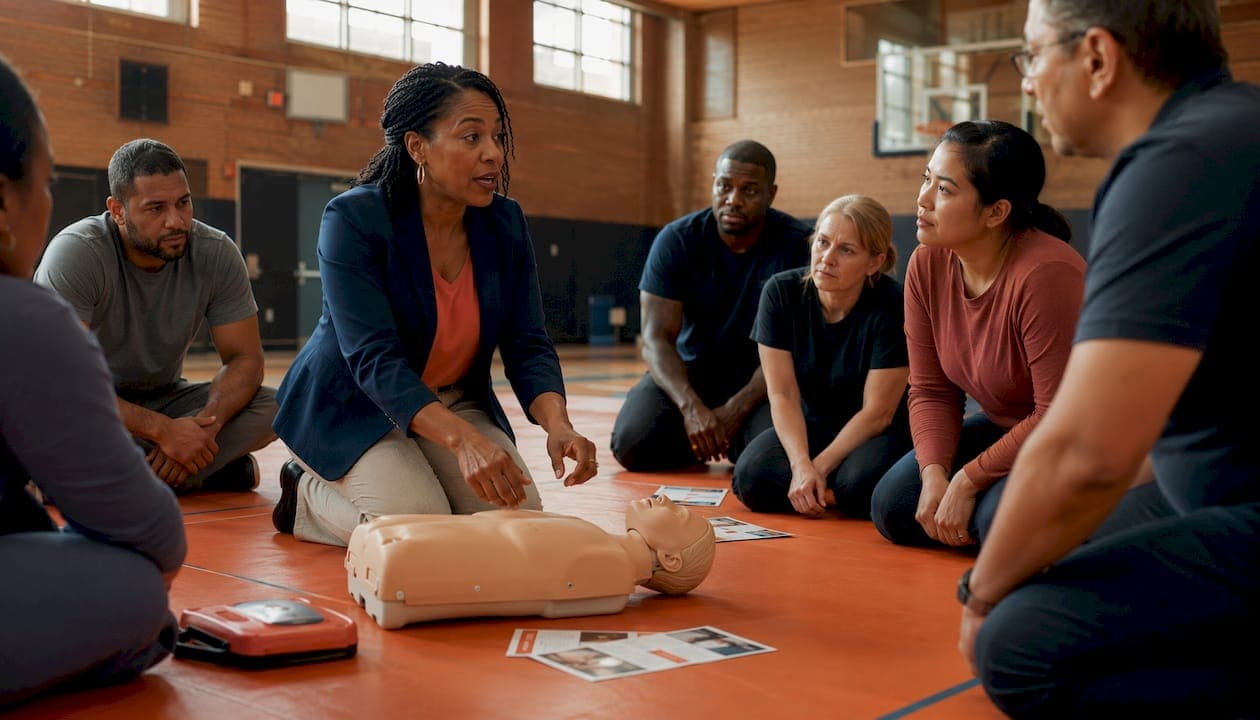
The fastest way to get your team certified is to contact an RN-led or credentialed mobile trainer, give them your headcount, preferred dates, and the certification type you need, and request a group quote. For workplaces and facilities in Charlotte, NC, Homefrontcpr delivers AHA-aligned Heartsaver, BLS, and First Aid classes directly to your location, with fast certificate issuance and flexible scheduling. Before you reach out to any provider, have three things ready:
- Headcount (minimum 4–5 learners for most private sessions)
- Certification type (Heartsaver CPR/AED for lay rescuers, BLS for healthcare staff, or First Aid)
- Any site-specific hazards you want the instructor to address (chemical exposure, pediatric care, industrial equipment)
That information alone cuts your quote turnaround from days to hours.
Table of Contents
- What does onsite first aid training actually include?
- Which course type matches your workplace need?
- Onsite vs. blended vs. virtual: which delivery model fits your team?
- What does onsite group training cost, and how far out should you book?
- What do employers need to confirm before booking?
- How do you verify a provider is actually qualified?
- What actually happens on training day?
- Why RN-led instruction produces better outcomes for many workplaces
- Key Takeaways
- The mistakes organizers make — and what trainers wish you knew
- Homefrontcpr brings certified RN-led training to your Charlotte workplace
- Authoritative sources for certification and compliance verification
What does onsite first aid training actually include?
Most group sessions cover a consistent core, though the depth varies by course type. Adult CPR, child and infant CPR (when requested), AED operation, basic wound care, bleeding control, shock response, choking relief, and scene safety assessment are standard across credentialed programs. What separates a quality provider from a mediocre one is how much hands-on time learners actually get.
Expect manikin practice for every participant, not just a demonstration at the front of the room. Reputable instructors bring AED trainers, bag-valve masks, and scenario cards so groups can work through team-based responses. Onsite sessions allow tailoring to your workplace layout and equipment, which improves real-world application in ways a public class simply cannot replicate.
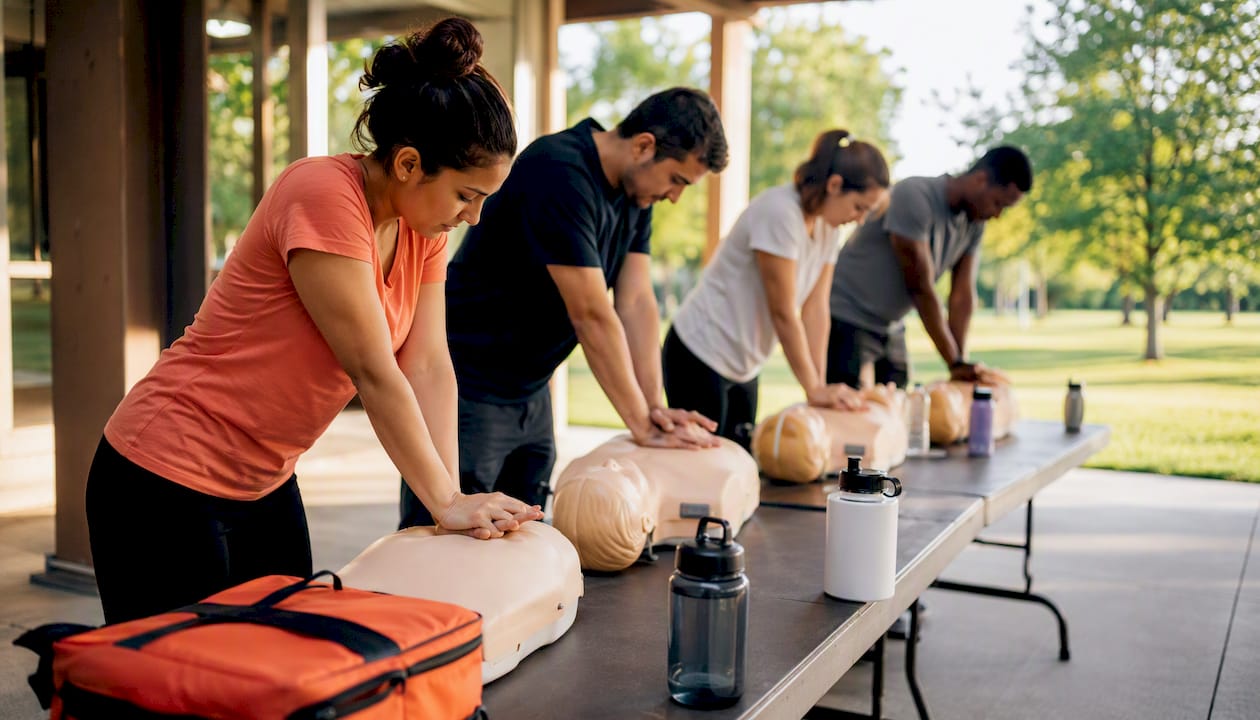
Providers typically supply all materials: manikins, AED trainers, student manuals, and printed or digital completion cards. If the course uses a blended model, learners receive a pre-course online module link before the session. The host's only job is the room.
Pro Tip: Ask every prospective provider for their student-to-manikin ratio before booking. A ratio worse than 3:1 means learners spend more time watching than doing, and skills retention drops sharply.
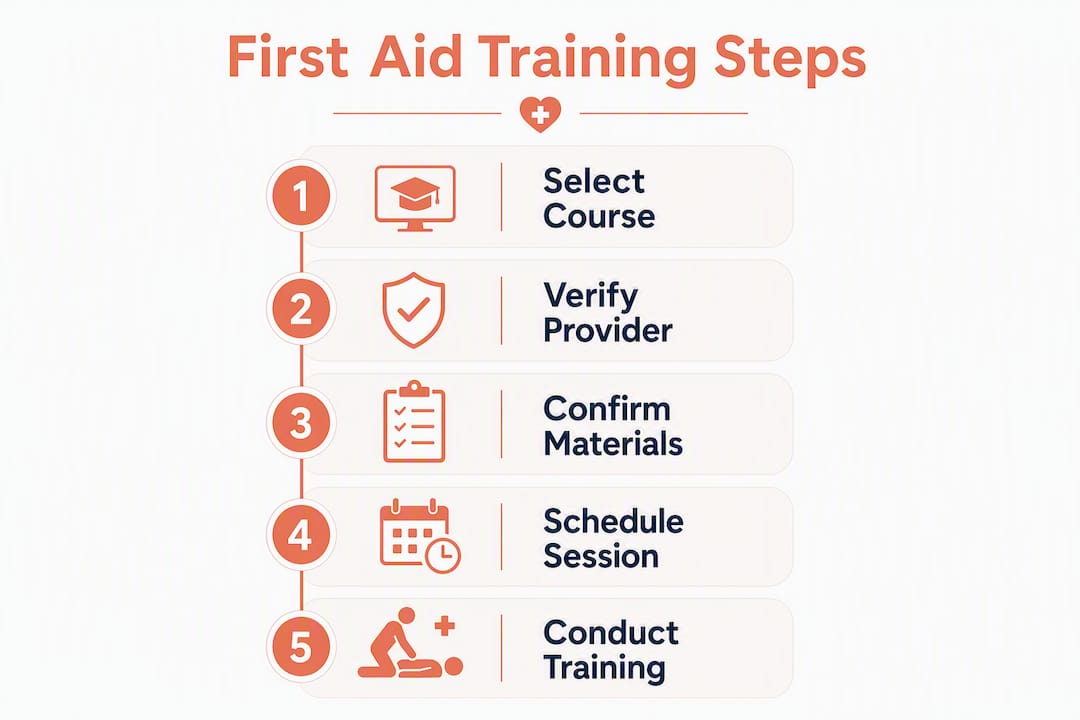
Which course type matches your workplace need?
Picking the wrong certification is one of the most common and costly booking mistakes. Misaligned certification types can render training unusable for regulatory compliance, so confirm what your organization or licensing body actually requires before you call anyone.
Common course types:
- Heartsaver CPR/AED — designed for lay rescuers (office staff, gym employees, school personnel); issued by the American Heart Association (AHA)
- BLS (Basic Life Support) for Healthcare Providers — required for nurses, MA's, EMTs, and clinical staff; AHA-issued; higher skill standard than Heartsaver
- First Aid — standalone or combined with CPR/AED; covers wound care, bleeding, shock, and environmental emergencies
- Pediatric First Aid/CPR — required for childcare workers, school staff, and parents of infants; covers infant choking and child-specific protocols
- Blended skills-only sessions — learners complete online theory independently, then attend a shorter in-person skills check; popular for recertification
The four major certification issuers you'll encounter are the American Heart Association (AHA), American Red Cross, National Safety Council (NSC), and Health & Safety Institute (HSI). AHA and Red Cross cards are the most widely accepted across healthcare, childcare, and corporate settings. NSC and HSI cards are common in industrial and safety-officer contexts. Card validity is typically two years for most CPR and First Aid certifications, after which a refresher or full recertification is required.
Onsite vs. blended vs. virtual: which delivery model fits your team?
Three delivery formats exist, and they are not equally suited to every situation.

| Format | Hands-on practice | Customization | Scheduling flexibility | Cert issuance |
|---|---|---|---|---|
| Fully onsite (instructor-led) | Full manikin time | High — site-specific scenarios | Flexible; trainer comes to you | Same day or next day |
| Blended (online + skills session) | Skills session only | Moderate | High; online portion is self-paced | After skills session |
| Fully virtual | None | Low | Highest | Varies; often delayed |
Fully onsite instruction is the right call for high-risk environments (construction sites, clinical settings, childcare facilities) and any group that needs equipment-specific drills. Mobile trainers offer fully in-person delivery or blended options where learners complete online theory and then attend an on-site skills session, which works well for larger groups trying to minimize downtime.
Fully virtual CPR training is not recommended when skills competency is the goal. Watching a video does not build muscle memory for chest compressions or AED pad placement. Regulatory bodies and most licensing inspectors expect documented hands-on practice, not a completion quiz.
Pro Tip: If your group is large and scheduling is tight, ask whether the provider offers a blended model where employees complete the knowledge portion on their own time. The on-site skills session can then run in 60–90 minutes instead of a half day, reducing lost productivity without sacrificing hands-on practice.
What does onsite group training cost, and how far out should you book?
Pricing for group sessions depends on several variables, and the range is wide enough that a ballpark number without context is nearly useless. Here is what actually drives the cost:
- Group size — most providers set a minimum of 4–5 learners for a private session; larger groups often bring the per-person rate down
- Number of trainers required — trainer capacity for first aid is typically around a dozen participants per trainer; CPR/AED sessions can accommodate slightly larger groups per trainer
- Certification issuer fees — AHA and Red Cross cards carry a per-learner fee built into the course cost
- Customization — site-specific scenarios, industry-specific modules, or pediatric add-ons add time and preparation
- Travel distance — most mobile providers charge a travel fee beyond a defined radius
- Blended prework — some providers include the online module in the group rate; others charge separately
Fixed-day pricing (one fee covering trainer, travel within a service area, materials, and certificates for a set group size) is a common model internationally and increasingly common in the U.S. It simplifies budgeting and removes the per-head anxiety for HR teams.
What to include in your booking request for an accurate quote:
- Preferred date(s) and backup date
- Total headcount and any split by certification type
- Site address and distance from the providers' base
- Specific workplace hazards or scenarios to include
- Desired start and end times
- Whether you need printed certificates on the day or digital delivery
Book popular dates at least 2–4 weeks in advance. Weekend and evening slots fill faster than weekday mornings, especially in Q4 when annual compliance deadlines cluster.
What do employers need to confirm before booking?
OSHA's 29 CFR 1910.151 requires employers to provide adequate first-aid supplies and trained personnel when a medical facility is not in near proximity to the worksite. "Adequate" is intentionally broad, which means the burden falls on the employer to assess their specific hazards and determine what training is sufficient.
Before booking, work through these employer-side action items:
- Run a first-aid needs assessment — identify the hazards present (machinery, chemicals, heights, patient contact) and map them to the skills your designated responders need
- Confirm industry-specific requirements — construction (29 CFR 1926.50), childcare licensing, and healthcare credentialing bodies each have their own standards that may specify issuer, course code, or renewal interval
- Check certificate acceptance — call your licensing body or safety inspector and ask which issuers they accept before choosing a provider
- Plan for recordkeeping — collect a copy of every certificate issued, log expiration dates in a shared calendar or HR system, and set 90-day renewal reminders
Refresher training every two years is standard for most CPR and First Aid certifications. Build that cycle into your onboarding checklist so new hires never start a role without current credentials.
How do you verify a provider is actually qualified?
Not every provider advertising "certified CPR training" delivers the same standard. Here is a structured way to evaluate before you commit.
Verification questions to ask every provider:
- What are your instructors' credentials? (RN, paramedic, AHA instructor certification?)
- What is your student-to-manikin ratio?
- Which certification issuer do you use, and can you show proof of affiliation?
- Can you provide a sample course outline or agenda?
- Are travel fees, materials, and certificates included in the quoted price?
- Can you customize the curriculum to our site-specific hazards?
Red flags to watch for:
- Vague answers about certification issuer ("we're certified" without naming AHA, Red Cross, NSC, or HSI)
- No proof of instructor credentials on request
- Certificates issued weeks after the class rather than same-day or next-day
- Inability to customize scenarios to your industry
- Hidden travel or material fees that appear after the initial quote
Credential verification is straightforward. AHA instructor affiliations can be confirmed through the AHA's training center network. Red Cross instructors are registered through the Red Cross Learning Center. If a provider cannot point you to their affiliation record, that is a problem.
Pro Tip: For organizations with multiple sites, designate one internal coordinator and use a single provider with a standardized curriculum. Centralized rollout keeps quality consistent across locations and makes certification tracking far simpler when renewal season arrives.
What actually happens on training day?
Knowing the timeline helps you set up the room correctly and brief your team in advance.
Typical training day sequence:
- Instructor arrival — most trainers arrive 15–30 minutes before the session start to set up manikins, AED trainers, and materials
- Introduction and course overview — 10–15 minutes covering objectives, emergency action plans, and legal protections (Good Samaritan laws)
- Skill modules — alternating instruction and hands-on practice; a Heartsaver CPR/AED class typically runs 3–4 hours; a BLS class runs 4–5 hours
- Scenario practice — team-based drills using workplace-specific situations
- Skills verification — instructor evaluates each participant's compression depth, rate, and AED steps
- Certificate issuance — printed or digital cards distributed before the instructor leaves
What the host needs to prepare:
- A quiet, well-lit room with enough clear floor space for all participants to kneel simultaneously
- Power outlets for visual aids and AED trainer charging
- A sign-in sheet with participant names and email addresses
- A designated point of contact who stays on-site for the duration
- Confirmation of any participants with physical limitations so the instructor can adapt
Hosts generally do not need a specialized medical room; a conference room or break area works well as long as there is enough floor space and access to power. The instructor brings everything else.
Why RN-led instruction produces better outcomes for many workplaces
Most CPR instructors are certified through a brief instructor course. An RN-led class draws on years of clinical experience, which changes the quality of the teaching in ways that matter when the stakes are real.
RNs bring clinical judgment to scenario design. When a manufacturing team asks "what do we do if someone's arm is caught in a press?", an RN instructor can walk through hemorrhage control, shock management, and how to communicate with EMS in a way that reflects actual clinical decision-making, not just a scripted module. Custom modules for specialized audiences — infant choking protocols, workplace-specific trauma, chemical exposure response — are more credible and more memorable when the instructor has managed those situations in a clinical setting.
Learner confidence is the outcome that matters most after the class ends. A participant who leaves knowing why 100–120 compressions per minute is the target, not just that it is, is more likely to act without hesitation in an actual emergency.
Homefrontcpr's model is built around exactly this: RN-led mobile delivery, AHA-aligned courses (Heartsaver, BLS, Pediatric First Aid), fast same-session certificate issuance, and flexible scheduling across Charlotte. Groups from gyms, schools, medical offices, and corporate facilities book through a single inquiry, and the instructor comes to them.
Key Takeaways
Instructor-led onsite first aid training requires confirming the right certification type, verifying instructor credentials, and providing headcount and site details before requesting a quote.
| Point | Details |
|---|---|
| Confirm certification type first | Identify whether you need Heartsaver, BLS, or First Aid before contacting any provider. |
| Minimum group size | Most private sessions require at least 4–5 learners; larger groups often reduce the per-person rate. |
| Verify instructor credentials | Ask for RN, paramedic, or AHA instructor status and confirm the provider's issuer affiliation. |
| Book 2–4 weeks ahead | Popular dates and weekend slots fill quickly; blended options can shorten on-site hours but still require a skills session. |
| Homefrontcpr for Charlotte groups | RN-led mobile training with AHA-aligned Heartsaver, BLS, and First Aid classes delivered to your location. |
The mistakes organizers make — and what trainers wish you knew
The most common problem on training day is not a skills gap in the learners. It is a logistics gap on the organizer's side. Unclear headcounts, rooms that are too small, and last-minute schedule changes account for the majority of sessions that run long or feel rushed.
Here is what experienced instructors consistently wish clients understood before the day arrives: the room matters more than people think. A group of 12 trying to practice compressions in a narrow conference room with chairs pushed against the walls is not a training environment, it is an obstacle course. Clear the floor before the instructor arrives, not after.
The second issue is attendance. Employees who are pulled out mid-session for "just a quick call" break the flow of scenario practice for everyone. Paid, protected time for the training session is not a luxury. It is what makes the difference between a team that can respond and a team that has a certificate on file.
Finally, gather post-class feedback. A short five-question form sent the same day captures what resonated, what confused people, and whether the scenarios felt relevant. That data makes the next session better and gives you documentation that the training was taken seriously.
Homefrontcpr brings certified RN-led training to your Charlotte workplace
If you are managing a team in Charlotte and need AHA-aligned certification without the logistics of sending staff to a public class, Homefrontcpr is the direct alternative. An RN instructor comes to your location, brings all equipment, and issues certificates before leaving.
Homefrontcpr covers Heartsaver CPR/AED, BLS for Healthcare Providers, First Aid, and Pediatric First Aid, with blended skills-check options for groups that need a shorter on-site session. Scheduling is flexible, including evenings and weekends, and the quote covers trainer fee, travel within Charlotte, all materials, and certificates.
To request a quote, send your preferred date(s), total headcount, certification type needed, site address, and any workplace hazards to include. Response time is typically fast. Book your group session directly through the Homefrontcpr website.
Pro Tip: Secure your preferred date by reaching out 2–4 weeks ahead. Weekend and evening slots book faster than weekday mornings, especially in the fall when annual compliance windows close.
Authoritative sources for certification and compliance verification
Use these primary sources to verify provider credentials, confirm OSHA obligations, and check certification standards before booking:
- OSHA 29 CFR 1910.151 — employer first-aid requirements for general industry; the baseline for workplace compliance
- American Red Cross — group and employee training programs including onsite delivery options and instructor locator
- American Heart Association — CPR facts and course standards; use to confirm AHA course codes and card validity
- National Safety Council (NSC) — First Aid, CPR, and AED training programs and onsite delivery information
- Red Cross Learning Center — instructor verification portal for confirming Red Cross instructor affiliations
- Minnesota Safety Council — onsite training scheduling reference for understanding how group programs are structured
Cross-reference any provider's claimed affiliation against the issuer's own directory before signing a contract. It takes five minutes and eliminates the risk of booking a provider whose certificates your licensing body will not accept.